 PL
 HU
 EN
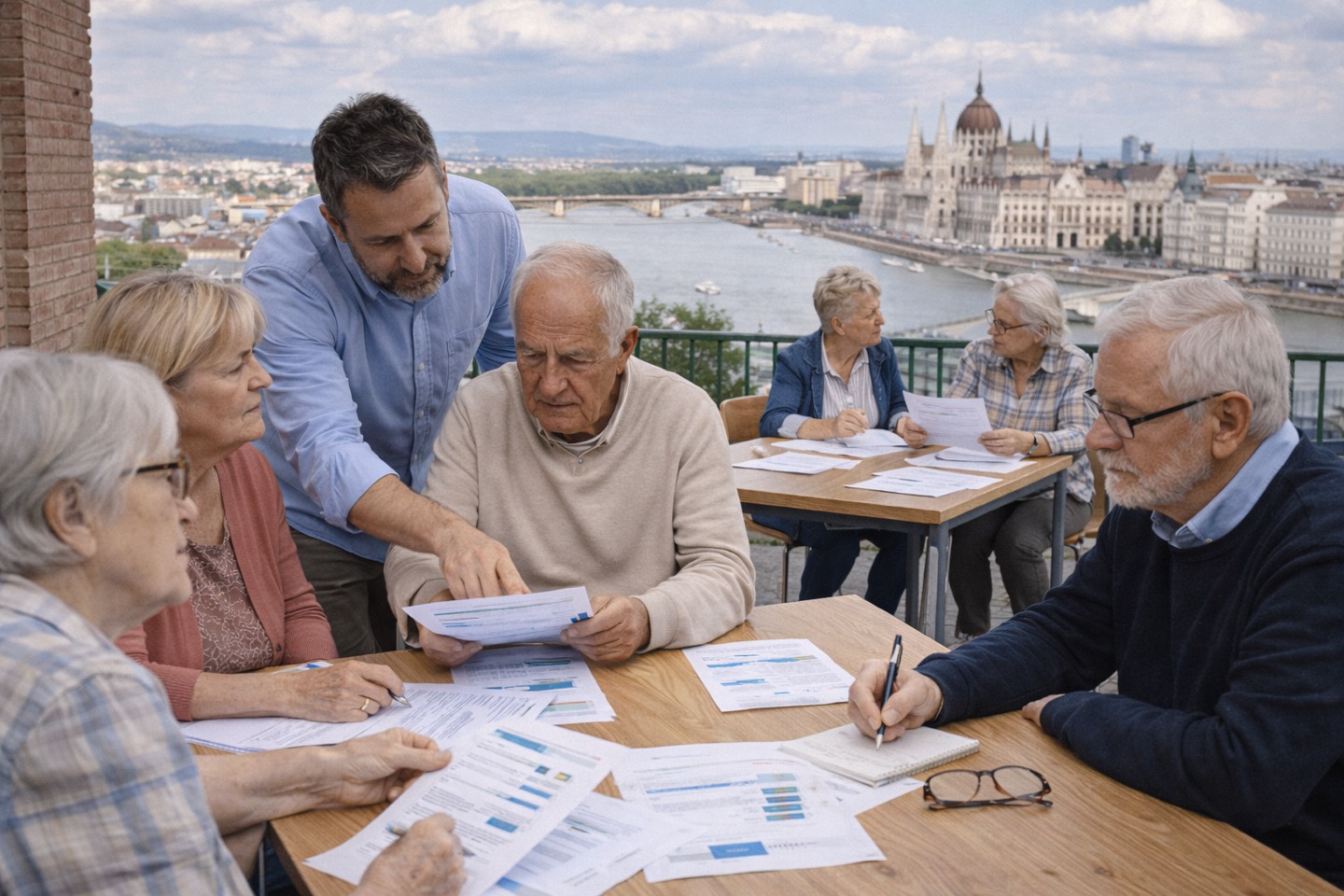
Over the past months we've been working on an online course, educational videos and teaching materials. Now it's time to step out from behind the screen and meet people face to face. From July 2026 we're launching a series of 20 in-person workshops | 10 in Poland (Kielce) and 10 in Hungary (Budapest). We plan to reach as many older adults as possible.
But before we get into the logistics, let's explain the most important thing: why in-person workshops when we already have an online course? The answer is simple | learning isn't just about transmitting information. It's also about experience, emotion and community. Research by Lisowska and Łojko (2025) clearly shows that combining online education with in-person workshops (the so-called blended learning model) produces the best results in educating older adults. The online course delivers knowledge | the workshops let people live it and practise it.
What to expect at a workshop
Each workshop lasts 90 minutes. Not longer | because research shows that after ninety minutes, older adults' concentration drops noticeably, and we want every minute to count. Not shorter | because we need time for practical exercises, discussion and a summary.
Groups of no more than 12 people
This is one of our non-negotiable rules. Jurczyk-Romanowska (2016) showed in her research that senior education is most effective in small groups, where every participant feels seen and safe. In a group of 12, the facilitator has time for individual attention, and participants are more willing to ask questions and share their experiences. By comparison | a typical "cybersecurity" training run by public institutions often takes place in rooms of 30-50 people. That might work for a lecture, but not for practising how to recognise a scam.
A multi-method approach
We won't spend 90 minutes reciting dry facts from slides. Every workshop is built on varied teaching methods | an approach the academic literature calls polymethodical. In practice, this means participants experience several different forms of learning within a single session.
We start with a short, engaging presentation of the problem | not dry statistics, but concrete stories. Real fraud cases from Poland and Hungary that show what the threats actually look like in practice. Then we move to a simulation | the most important part of the workshop, which we'll say more about shortly. After the simulation comes time for discussion | what happened, what emotions the participants felt, what surprised them. Then a practical exercise | for example, jointly checking whether a given website is real or fake. Finally, every participant gets a checklist | a summary of the most important safety rules that they can take home and put up next to the phone.
The structure of every workshop
Although the topic of each workshop differs (one covers phone scams, another fake investments, another online shopping), every session follows the same four-part structure:
Part 1: Simulation (about 25 minutes). Participants take part in a realistic staged scam. They don't know in advance what scenario awaits them | the element of surprise is key, because in real life scams also arrive unexpectedly.
Part 2: Discussion (about 20 minutes). The facilitator discusses with the group what happened. What warning signs appeared in the simulation? What did participants notice, and what did they miss? What emotions accompanied their decisions? This part is crucial | this is where the real learning happens, as participants analyse their own reactions.
Part 3: Practical exercise (about 25 minutes). In pairs or small groups, participants carry out a concrete task: checking whether a website is genuine, analysing a suspicious text message, practising a conversation with a "suspicious" caller. The facilitator helps and gives feedback.
Part 4: Checklist and summary (about 20 minutes). Every participant receives a printed checklist with the most important safety rules related to the workshop's topic. We go through each point together, answer questions, and resolve doubts. The checklists are designed to be put up somewhere visible | next to the phone, on the fridge, beside the computer.
Scam simulations | the key element
Simulations are the heart of our workshops, and what sets ODYSSEY apart from other educational programmes. We were inspired by the Czech project "Nedame se" (Mazalova, 2016), the only one in Central and Eastern Europe to scientifically prove that scam simulations effectively change older adults' behaviour | participants in the programme showed twice the caution of the control group.
What do our simulations look like? We've prepared over a dozen scenarios that mirror the most common types of scams targeting older adults in Poland and Hungary. Here are a few examples:
Phone scenarios
The facilitator (or a trained volunteer actor) calls the participant's phone from an unknown number. They claim to be a grandson who's had an accident. They ask for urgent financial help. They say not to call anyone else. The participant has to decide how to react | and then the whole group discusses the situation. In another scenario, a "bank employee" calls, informing the participant of a "suspicious transaction" on their account and asking for their login details.
Text message scenarios
Participants receive pre-prepared text messages on their phones | imitating notifications from a bank, the post office, a tax office. They have to judge which messages are real and which are fake. They learn to recognise the characteristic features of phishing texts: typos, suspicious links, time pressure, requests for personal data.
Offline scenarios
Not every scam happens online. We've also prepared "at home" scenarios | for example, a staged visit from a fake gas inspector who wants to enter the flat and asks to see documents. Or a scene where a "neighbour" asks for a quick loan because "the cash machine isn't working". These scenarios are especially important for older adults who rarely use the internet but are exposed to scams "in real life".
Debriefing | the key to effectiveness
Taking part in the simulation alone isn't enough. The key element is the debrief | a detailed discussion of what happened. Konieczna (2025) emphasises in her research that reflection after an educational experience is decisive for how durably the knowledge sticks. During the debrief, the facilitator doesn't judge participants | they don't say "you did that wrong" or "you fell for it". Instead, they ask: "What did you feel at that moment?", "What made you decide that?", "If you could go back, what would you do differently?". It's a safe space to learn from your own experience | without shame or judgement.
Where and when?
Poland | Kielce
In Poland we're planning 10 workshops, taking place in Kielce between July and September 2026. The workshops will be organised in partnership with the Regional Volunteer Centre in Kielce (RCW), the Polish partner in the ODYSSEY project. RCW has many years of experience working with older adults and an excellent network of contacts in the local community.
The workshops will take place in accessible locations | rooms in cultural centres, libraries and senior centres. We've made sure the venues are easy to reach by public transport and free of architectural barriers. To find out specific dates and addresses, contact the Regional Volunteer Centre in Kielce (+48 41 362 14 12).
Hungary | Budapest
In Hungary we're organising another 10 workshops, this time in Budapest. Our Hungarian partner | the Institute for Cultural Relations Policy (ICRP) | is responsible for them. The workshops will be run in Hungarian, using the same simulation scenarios but adapted to the Hungarian context | different phone numbers, different institution names, different typical scams. The schedule is the same: July-September 2026.
Running workshops in parallel in two countries lets us do something very valuable scientifically | comparing experiences and results. Do older adults in Poland and Hungary react similarly to the same types of scams? Do cultural differences affect susceptibility to manipulation? Do educational methods that work in one country hold up in the other? These questions don't yet have answers in the academic literature | ODYSSEY will help find them.
Who is it for?
ODYSSEY workshops are aimed at three main groups:
Older adults 60+
This is our main target group. We welcome everyone over 60 | regardless of their level of technological experience. You don't need to know how to use a computer to benefit from our workshops. Many scenarios cover phone and "at home" scams that require no digital skills at all. At the same time, we've also prepared materials for people who use the internet and want to do it more safely.
Pawłowska-Cyprysiak (2022) emphasises in her research that educational programmes for older adults should be inclusive | covering both the "digitally excluded" and "digital beginners". At ODYSSEY we try to put this principle into practice: no one is "not advanced enough" for our workshops.
Caregivers
We also welcome people who care for older adults | adult children, grandchildren, neighbours, social care workers. Caregivers play a key role in protecting older adults from scams. They can help set up a phone, install anti-phishing filters, and regularly talk about new threats. At the workshops, caregivers will learn which scams are currently most common, how to talk to an older adult about safety (without being patronising!), and what simple steps they can take to reduce risk.
Educators
The third group is people who work with older adults in an educational role | cultural facilitators, librarians, staff at Universities of the Third Age, volunteers. For them, ODYSSEY workshops are not just a source of knowledge but also methodological inspiration. We'll show how to design engaging educational sessions, how to run simulations, how to build a safe space for learning. All our materials | simulation scenarios, checklists, presentations | will be made available for free use.
Participation is free
We want to make this clear: participation in all ODYSSEY workshops is completely free. The project is funded by the European Union's Erasmus+ programme, which means we don't charge participants anything. There's no need to register far in advance either | just let us know you'd like to take part, and we'll reserve a place.
We believe financial and digital safety shouldn't be a privilege for those who can afford expensive training. It's every older adult's right | and it's our job to make that right a reality.
If you'd like to take part in the workshops, follow the schedule, or suggest your institution as a venue | visit our website, check the Events page, or write to us through the contact form. See you in May!